
This article will be updated as the state of the academic literature evolves; you can read the latest version here.
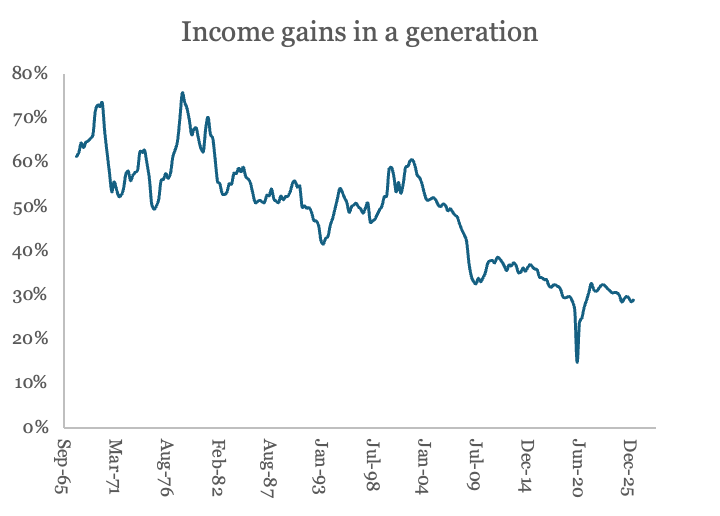
The average 20-year growth rate in the USA between 1967 and the 2008 financial crisis was 56%. In 2026 the preceding 20 years of growth were nearly half that level, at 29%. Over their lives, the generations born after roughly 1990 have experienced much lower growth than was the norm in the 20th century. A variety of recent research suggests that slowdown has had an impact not just on material living standards, but also on their beliefs and attitudes.1
Grading Government
Let’s start with two papers that adopt a similar methodological approach: Besley, Dann, and Dray (2026) and Acemoglu et al. (2025). Both papers assemble responses to a large number of surveys that were administered across more than 100 countries over several decades (1990 through 2019 for Besley and coauthors, 1981 to 2018 for Acemoglu and coauthors). The surveys give them data on the views of many respondents in many countries, at several points in time. They also know the age of each survey respondent, which they use to reconstruct their experience of economic growth over their life. For example, a 20-year-old American in 2026 has experienced average annual growth of 1.3% over their life.2
That gives them a lot of variation to assess the effects of growth on people’s views. For example, they can compare the views of people who are the same age, but live in different time periods or different countries, or compare people of different ages, in the same country at the same time. These people have all experienced different rates of growth over their life and the authors can see how that is correlated with their answers to survey questions.
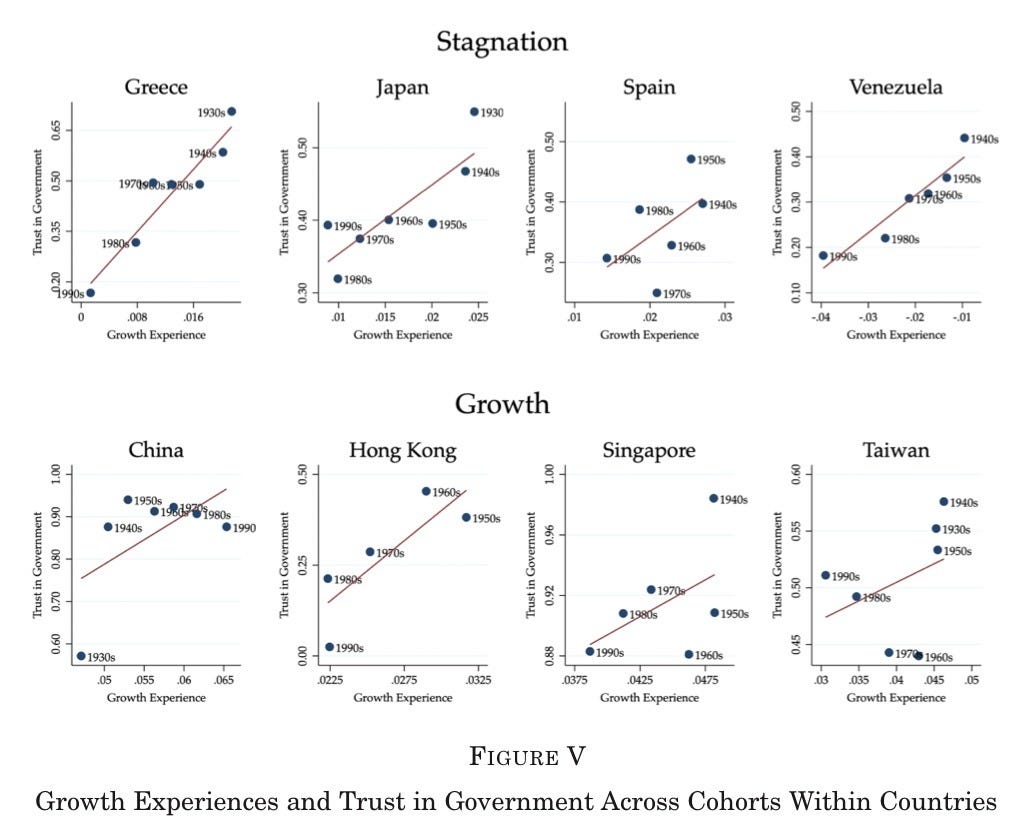
For example, Besley and coauthors focus on how growth experiences are related to trust/confidence in government: they find that the higher the level of average economic growth one has lived through, the more trust/confidence they have in their government. Have a look at the figure above, which plots data from eight countries, half of which grew quickly and half of which grew slowly. Within each country, respondents born in years that went on to experience slow growth over their lifetimes tended to have lower trust in government than those who were born in years where growth was faster. But look also at the axes of these figures: the growth set of countries have higher values of growth experience (horizontal axis) and higher levels in trust in government as well (vertical axis).
Besley and coauthors also get similar results when they look at perceptions of corruption; respondents who have experienced slower growth say their government is more corrupt than those who experienced faster growth. A key part of their analysis also compares the importance of recent and more distant rates of growth - in their core analysis, growth rates in the most recent half of a respondent’s life get three times the weight of growth in the first half. To get a sense of the magnitudes of the growth-trust relationship, they find, for example, that the slower growth experienced by US millennials compared to baby boomers accounts for two-thirds of the gap in trust between these groups. Alternative models with more controls find a smaller effect - possibly as small as a quarter of the size of the effect in the main specification.3
The other paper, by Acemoglu and coauthors, instead focuses on various questions about support for Democracy, such as how much the respondent agrees with the statement “Democracy may have problems but it’s better than any other form of government” and variations on that theme. Their first result doesn’t look at economic growth, but instead just at experience living in a democratic country. Here, they find that more life lived under a democratic government is associated with more support for democracy. However, their followups look at the combination of life under a democracy and various measures of performance and in these analyses they find that economic growth matters a lot. Indeed, it turns out that the positive relationship between “years spent living under a democracy” and support for democracy are mostly driven by years spent living under a democracy that also is not experiencing poor economic growth. “Poor economic growth” is defined in various ways in different analyses, but the result is pretty consistent. Respondents who spend more time in a democracy that is also experiencing decent levels of growth are stronger supporters of democracy; but if you spend more time living in a democracy with weak growth, you are not more supportive of democracy.
Besley and coauthors obtain some complementary results here. They find that the relationship between trust in government and experiences of growth is stronger in Democracies than in Autocracies.
We can also turn to Park (2026) for another line of evidence on these questions. Rather than inferring what people think from surveys, Park reads their tweets. Park trains a classifier to identify billions of tweets from 2013-2022 as being political or non-political.4 She then combines that with a Google text analysis effort to measure the animosity of tweets. The combination lets her identify the level of political animosity in tweets, and since tweets are geo-located, she can infer how regional growth is correlated with how people tweet about politics.
Park’s analysis focuses on France, the USA, and Korea. For each country she computes measures of economic growth at the sub-national level; for example, in the USA, she finds the growth of median household income in every US county in the years running up to the beginning of her twitter data. She finds political animosity of tweets is higher on average in the US, France, and Korea in sub-regions with lower economic growth, relative to other regions in the country, in the preceding decade. So at least in the 2010s, not only is there an association between experiences of growth and what people say about their government in surveys, but also in how much they tweet negative things about politics in general.
A special relationship?
Broadly speaking, the preceding results suggest the experience of economic growth is an important input into how people judge the performance of their government and their systems of government. Low growth is associated with lower faith in one’s government, especially in democracies. It’s also associated with perceptions that one’s government is more corrupt, and decreased faith in democracy as a system of government. These results seem consistent across a large sample of countries and spanning a long time frame, and strike me as pretty intuitive.
Is growth unique in this respect? Do other markers of government performance have similar effects? The evidence here is a bit mixed. Besley and coauthors examine a battery of other variables that respondents might view as reflective of their government’s performance but they are only sporadically related to faith in government. In their international sample, financial crises and inflation are not associated one way or another with trust in government, and neither are measures of stock market performance, inequality, and unemployment in some longer running analyses they have for the USA and Switzerland. They do find unrest (for example, riots, revolution, antigovernment demonstrations, guerrilla warfare, general strikes, and assassinations) is negatively associated with trust in government. And, notably for understanding our current moment, they find that exposure to epidemics is associated with decreased trust in government. This is not simply because trust in government has fallen after COVID-19: an earlier paper, Eichengreen, Saka, and Aksoy (2024), used a dataset that preceded the global pandemic but still found that exposure to epidemics during formative years led to decreased trust in government. Meanwhile, Acemoglu and coauthors find that civil wars and low levels of government spending are also each associated with less support for democracy, in addition to slower economic growth.
We might also worry that the correlation between growth and trust in government is causally driven by some third thing that we don’t observe, but which causes the two to rise in parallel. For example, maybe societies can get more competent (for example, via educational reforms?) and this leads to both faster economic growth and a more trustworthy government. To help test this, both papers also look to see if economic growth rates prior to a respondent’s birth also affect their responses. The idea here is that, if some secret third thing is correlated with both growth and assessment of government, then this thing might have been present in a society before one was born and we could see a correlation between pre-birth growth rates and contemporary assessments of government. But if the primary thing happening is people are looking at their own experience of growth and then rendering a verdict on their government, growth that happens before they are born shouldn’t matter. And both papers find growth rates before a respondent is born are not predictive of their assessment of government.
We can also turn things around and ask if growth affects the evaluation of more than one’s system of government. Besley and coauthors show that growth is not much associated with how much respondents trust their countrymen or other non-governmental institutions, such as religious organizations. Acemoglu and coauthors obtain similar results - the things that drive support for democracy as a system of government are not much correlated with a battery of other non-political attitudinal variables. Neither is there much evidence that growth contributes much to things like life satisfaction, once you take into account the level of GDP per capita. I’ve looked for papers on this, but haven’t found anything that I quite liked (though please send suggestions). I suspect this is because when I’ve tried to run the numbers myself, I get a null result. GDP per capita is robustly correlated with reports of life satisfaction, but when comparing people with similar levels of income per capita, I don’t see any evidence that the ones who have experienced faster long-run growth report higher levels of life satisfaction.
Where does value come from?
While slower growth isn’t associated with non-political attitudes in general, there is one exception. A 2026 paper by Chinoy, Nunn, Sequieira and Stantcheva (2026) argues that growth (and economic experience more broadly) affects beliefs about where value comes from. Specifically, they look at “zero sum thinking”, namely the idea that there is a fixed amount of value. Zero sum thinking, in this context, means that when one group gets more value, another group is getting less. If you hold fixed the size of the economy, then it is mathematically true that more income for one means less income for another, and so we might expect slower rates of growth to lead more people to think this way.
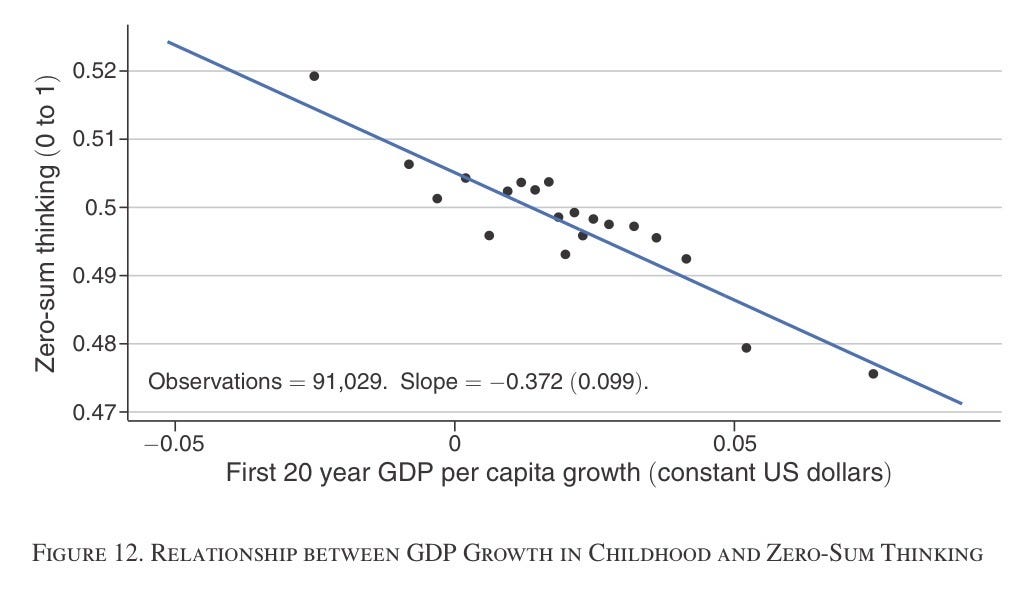
Chinoy and coauthors present a couple strands of evidence on this. One analysis follows the blueprint laid out above and looks at international survey data (72 countries, spanning 1990-2014).5 The surveys they look at ask respondents to place themselves on a scale between two extremes. On one extreme is the statement “Wealth can grow so there’s enough for everyone” and on the other extreme is “People can only get rich at the expense of others.” In this international survey response, they find that respondents who experienced slower economic growth in the first 20 years of their life place themselves closer to the latter statement (the zero sum statement). Controlling for a variety of respondent characteristics, every additional percentage point of average growth the respondent experiences is associated with a 0.004 shift on 0 to 1 scale away from the zero-sum response.
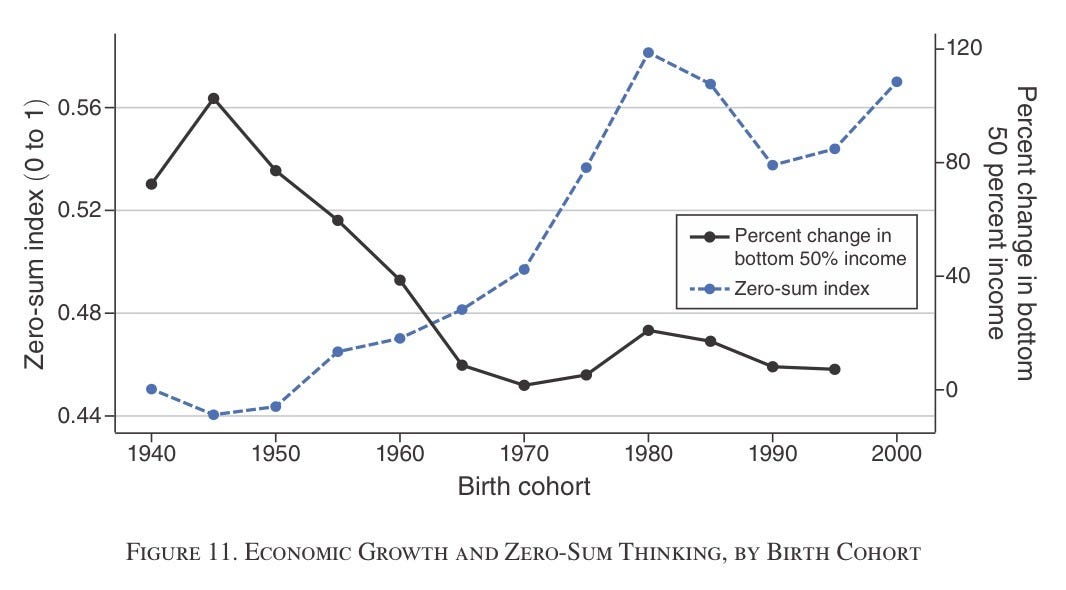
For the United States, the authors also field their own large survey (more than 20,000 respondents) for which they can design a more precise measure of zero-sum attitudes. They ask respondents how much they agree with four different statements about whether one group benefits primarily at the expense of others (the groups are based on ethnicity, citizenship status, country of residence and income class). They use a mix of responses across different questions to get a measure of zero-sum thinking that is less dependent on feelings about any particular context. In their sample of US respondents, they find that their measure of zero-sum thinking is lowest for people born in years when economic growth among the bottom half of the population was high and vice versa. Their survey also finds other evidence of a link between economic performance and zero sum thinking: people who experience more income mobility in their life and immigrants to the United States both report lower zero sum thinking. Immigrants to the USA, for example, are about 0.04 points less zero sum on a zero-to-one scale.
The paper also documents that while zero-sum thinking is not primarily associated with a particular political party (it’s a bit more common on the left in the US, but there’s plenty on the right too) it is associated with support for some particular policies. People who view the world as more zero sum tend to support more policies that redistribute resources from more advantaged to more disadvantaged groups, and to support more restrictive immigration.
A culture of slowing growth
If we take the preceding at face value, it implies the dramatic slowdown in long-run average growth in the US from 2008 on should lead to declining faith in the government (including a greater belief that it is corrupt), declining faith in democracy as a system, and an uptick in interest towards policies that redistribute resources and restrict immigration. It would also be no surprise that anti-incumbent parties with similar policy positions have done well in the present moment.
That said, to close, it’s worth noting that while growth is a big deal, it’s not the only thing that matters. Park (2026), in particular, proposes a more nuanced theory than “low growth leads to political dissatisfaction.” In her paper, relatively less prosperous places generate the initial electoral demand for populist anti-government parties in a subset of the population, but whether those parties end up winning, and how their rhetoric changes (or does not) after winning, influences the rest of the country’s attitudes towards government (as reflected in the political animosity of their tweets).
More broadly, the papers we’ve looked at find that changing growth rates can account for a meaningful share of changing beliefs around government and zero-sum thinking, but generally much less than 100%. And they don’t seem to have any relationship to a variety of other expressed beliefs. Nonetheless, even if growth isn’t everything, it’s not nothing either. We tend to think of growth as mostly having an impact on our lives through its impact on our material wellbeing; but growth has non-material effects as well.
Thanks for reading! I’ve missed posting here too much, and so after a hiatus of more than a year, I’m back. I won’t be able to post as much as I did in the old days, but I have a few things partway drafted already, so watch this space!
Bonus Discussion
In the interests of keeping posts shorter, New Things Under the Sun tends to give short shrift to intellectual history; I focus on our best guess at answers to some question, rather than the journey that got us here. But in this particular case, I can’t help but point to the seminal work on this question, Benjamin Friedman’s 2005 book The Moral Consequences of Economic Growth.
Friedman argued “The value of a rising standard of living lies not just in the concrete improvements it brings to how individuals live, but in how it shapes the social, political, and ultimately the moral character of a people.” (p4) Friedman argued, via a recounting of the history of growth and policy changes across a range of countries that “merely being rich is no bar to a society’s retreat into rigidity and intolerance once enough of its citizens lose the sense that they are getting ahead.” (p5) The following table does a good job of concisely summing up his argument, at least for the US portion of the book.
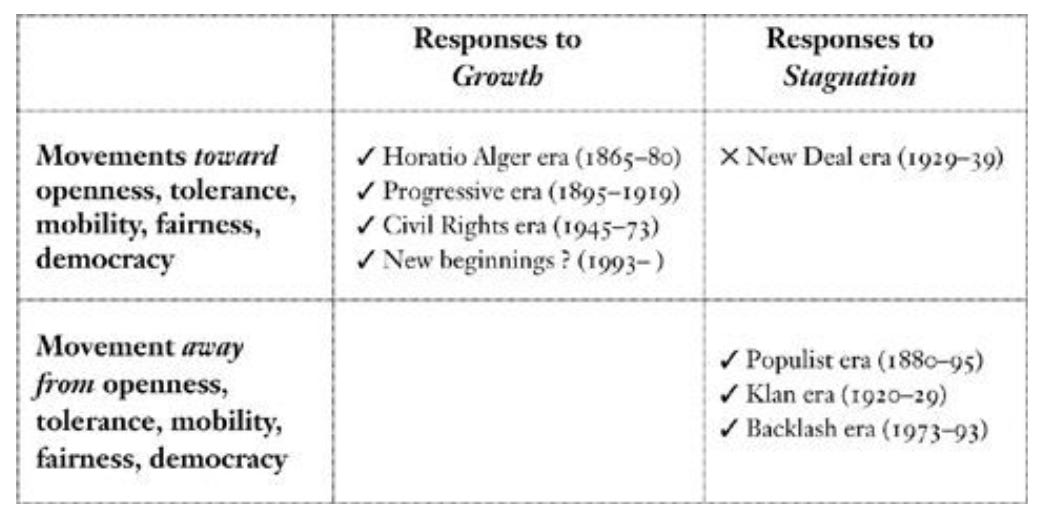
In Friedman’s telling, periods of broadly shared rapid economic growth are associated with more pro-social national policy, and sluggish growth the reverse (with the New Deal response to the Great Depression a notable exception to the trend). The recent papers covered in this post introduce a few nuances to Friedman’s survey of American (and world) history.
Some of this work pretty directly supports Friedman’s argument. For example, Acemoglu and coauthors find that economic growth is conducive to greater support for democracy as a system of government. And Chinoy and coauthors find that growth leads to less zero sum thinking, which is associated with less restrictive immigration policy.
But other elements are more equivocal. For example, zero-sum thinking is also associated (at least in today’s world) with a greater support for policies that help disadvantaged people. It might, for example, help explain support for New Deal era policies, which are otherwise a bit of a puzzle for Friedman’s framework. Second, while Friedman’s model might imply that growth leads people to view their neighbors more favorably in general, both Besley, Dann, and Dray (2026) and Acemoglu et al. (2025) find that growth isn’t strongly associated with non-political beliefs. Finally, a third major theme of this post is that growth is associated with increased faith in government - it’s not immediately clear how this links to Friedman’s framework. Maybe greater trust in government allows it to take on more ambitious projects, and the kinds of projects that governments take on tend to have public good characteristics that reflect fairness and provide help for disadvantaged groups?
Finally, while I didn’t emphasize this too strongly in the post, the papers also raise some interesting questions about when growth leads to the kinds of pro-social policies that Friedman is interested in. For example, Chinoy and coauthors focus on the deep roots of zero-sum thinking, arguing that it is our experience of growth during our first 20 years of life (or even our ancestor’s experiences) that shape our tendency to think in zero sum terms. Meanwhile, Besley and coauthors emphasize that it is the more recent growth performance that counts for most in determining our trust in government. Does the synthesis of these two imply that it is slow growth followed by fast growth that is most conducive to ambitious government policy to reduce inequality? Taking the papers at face value, recent experiences of fast growth would lead an electorate to have trust in their government (possibly to enact ambitious policies?) while historical experiences of slow growth would lead them to have deep seated preferences for redistribution.
There’s also a large literature on the economic roots of the recent rise of populism - see Guriev and Papaioannou (2022) for a good overview. This post won’t cover that. Instead I am going to focus on economic growth and its impacts on attitudes and beliefs more generally, not its impact on voting behavior.
Where 101.3% compounded over 20 years is 129%.
I’m comparing the size of the coefficient in Table 1, column (2), to the size of the coefficient in Table 3, column (1), from which the US illustration is drawn.
Park has more data for the USA and France, fewer years for South Korea.
They note in footnote 12 that this question was asked in waves 2, 3, 5, and 6 of the World Values Survey, which apparently were conducted between 1990 and 2014.